
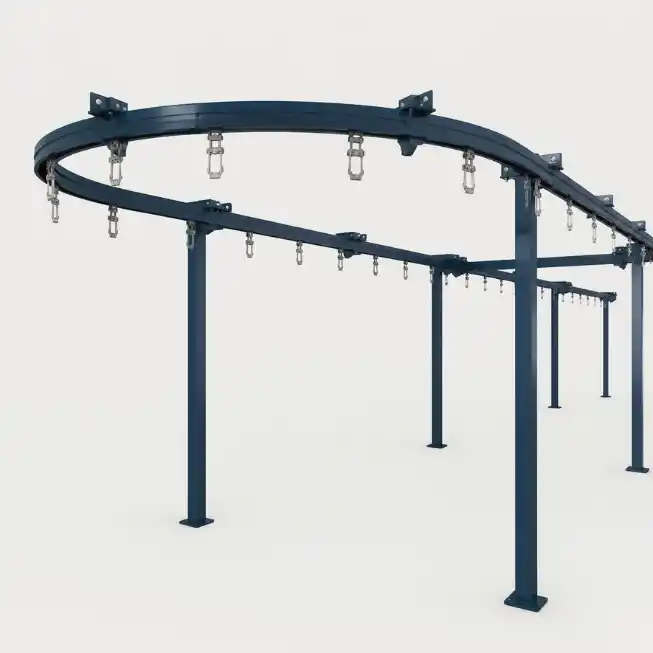
Weekly Highlight: Overhead Conveyor System
2-3 Minute Read ⏱ Categories: Conveyor, System Design
Solutions Looming Overhead
There are many big problems that overtake a business’s manufacturing operation.
A few of these issues may be space, storage, downtime, and irregular products. In some specific cases, it could be more than one of these issues at a time affecting your production. We have seen this happen in many of the factories we’ve worked with. That’s why Russell Conveyor helped develop a solution that could move these irregular products and save space for these companies.
In this blog, we’ll highlight the capabilities of our overhead conveyor systems. The purpose of this system can vary and change depending on the desired industrial use. But what remains the same is the excellent quality and design that we pride ourselves on. Finally, we’ll discuss the advantages and disadvantages of owning a machine like this, and how it could affect your current business plans.
What Is an Overhead Conveyor?
The first thing to address is “what exactly is an overhead conveyor system?” These units are exactly that; they’re able to transport items overhead out of the way of everyday warehouse traffic. Much like our spiral solution, we develop our systems to help maximize the space in your warehouse. And like our other hand-crafted solutions, we make sure that whatever you require from a machine is custom-designed to integrate into your warehouse.
Now that a general introduction is in place, let’s talk about the two different types of overhead conveyors: enclosed track and I-beam.
Enclosed track
What makes this type of overhead equipment special is its ability to protect its sensitive components. In industries that generate lots of dust and airborne grime, it can start to collect and build in certain key areas. Once this buildup becomes obstructive, it can start to alter the performance and quality of the equipment. With a completely enclosed track, its ability to keep dust out is rivaled by no other. Any equipment that needs to operate in a dust heavy environment, using enclosed tracks is the definitive way to operate.
I-Beam
Need extra support for your heaviest products? With the I-beam system, you’re able to move your larger items overhead with ease. Unlike the enclosed track, the I-beam was built for carrying capacity. With this unique type of unit, you can easily transport items up to 250lbs. To put this in perspective, that’s enough to lift an adult female gorilla (although we don’t advise doing this).
Advantages and Disadvantages
After fully covering both types of overhead conveyors we offer, you still may be wondering how exactly does this help? Here are a few ways this system can affect your production timeline:
- Efficient transportation
- Reduced environmental hazards
- More warehouse space
- Increased production
Even with how beneficial these machines can be, there are some downsides to owning them. Some of the most common include:
- Specialized maintenance
- Specific required uses
- Upfront cost
How Can Russell Conveyor Help?
Russell Conveyor has been one of the leading suppliers of conveyor solutions for over 20 years. We’ve seen various warehousing and manufacturing layouts, and can custom integrate our systems into any preexisting design. Our skilled technicians and engineers pride themselves on their work and deliver the best quality. We were founded on this quality and have no plans to change this groundwork.
Ready to see what an upgrade can do for you? Call us today at (336) 526-3014.
Interested in seeing our other high performing products? Check out this page for more options.
Can’t determine if you need a new machine or not? Read our blog post about how to track your equipment performance.
FAQs about Overhead Conveyor Systems
Have any questions about overhead conveyor systems? Here we share more information about overhead conveyor systems.
Its main function is to clear space for general warehouse traffic while still moving product.
Yes. we pride our designs on being fully customizable and easy to integrate.
Enclosed is built to protect essential conveyor components, while I-beam systems are built to carry heavier products.
If used properly, overhead conveyors can speed up timelines dramatically as there is more space to operate on the warehouse floors.