
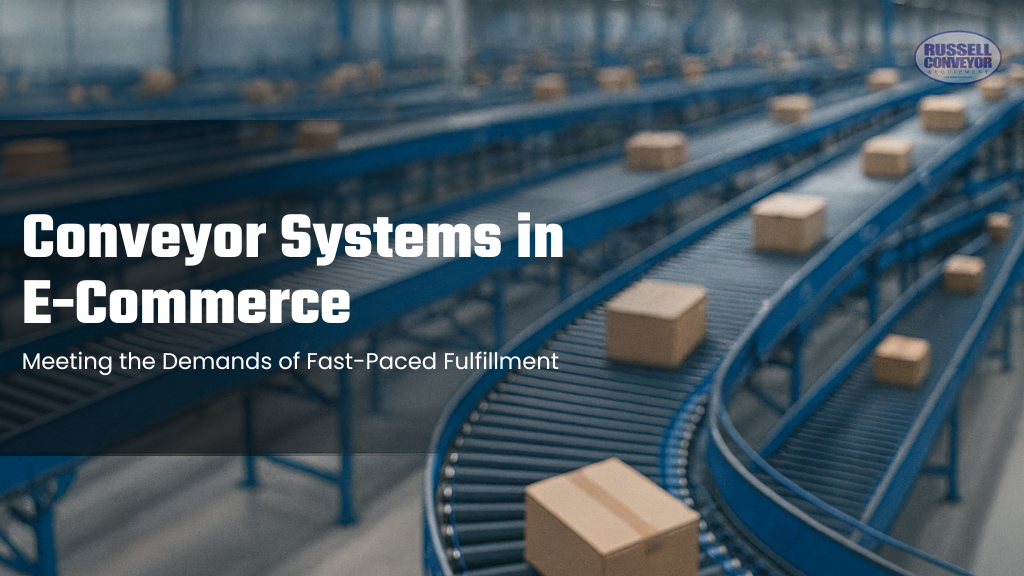
Automated Conveyor Systems for Logistics
If you’ve ever had to manage order fulfillment during the holidays, you know just how quickly things can fall apart. For many e-commerce businesses, the real challenge isn’t just selling the product, it’s getting orders out the door on time, every time.
That’s why having the right conveyor setup makes all the difference. Conveyor systems for order fulfillment operations keep your whole operation flowing, no matter what you take on.
In this blog, we’ll explore why automated conveyor systems are such an important part of e-commerce operations, small and large. If you’re a business owner hoping to boost your operational potential, adding automated conveyors might be right for you.
Conveyor Systems are Integral to E-Commerce
The e-commerce world moves fast. Customers want their items yesterday, and anything slower than two-day shipping can cost you business. If your warehouse relies on manual work, you’re eventually going to hit a ceiling.
This is one of the biggest reasons that conveyor systems have become a must-have for online retailers, no matter the product. Automated conveyor solutions speed things up, improve accuracy, and reduce workload and overhead costs. It’s a win-win, at any scale.
The Benefits of Conveyor Systems in E-Commerce Fulfillment Centers
Reducing manual labor needs is a big part of streamlining fulfillment and logistics centers. But how does adding a conveyor system help your business specifically?
- Faster Turnaround Times
You’ll be able to move more product, faster, with less effort. You’ll be able to produce more, quicker, and with less cost to your bottom line.
- Better Order Accuracy
Fewer gaps in your production flow reduces the chances for things to go wrong.
- Cleaner Workflow
Streamlining your production setup minimizes the possibility for hangups, slowdowns, or errors.
- Flexible Staffing
Your employees are free to focus on what really matters instead of just carrying stuff from point A to point B.
- Room to Scale
As demand increases, you can modify your conveyor system without overhauling your entire operation.
Types of Conveyor Systems Used in E-Commerce
The right conveyor system depends a lot on your floor space, product size, and how many orders you’re handling.
- Belt Conveyors
Belt conveyors are common in e-commerce. They utilize large belts and motors to pull materials along a horizontal axis and are great for quickly moving products of different sizes and weights. Check out this article on Conveyor Belt Systems.
- Overhead Conveyors
These conveyors are great for situations where space is limited. They free up floor space and can be routed above active work areas to help you maximize usable workspace. Explore more about Overhead Conveyors.
- MDR (Motor-Driven Roller) Conveyors
An MDR conveyor uses motorized rollers to move materials along a predetermined track. They’re a highly popular option for e-commerce and can come in an extensive variety of types and configurations.
- AGVs (Automated Guided Vehicles)
These robotic carts move items across your warehouse without needing a fixed path. They can be automated to work efficiently with minimal human interaction. Know more about AGVs.
How Conveyor Systems Help the Customer Experience
Most customers never see your warehouse, but they’ll feel its impact. When your systems are dialed in, orders ship faster, arrive intact, and are more likely to be right the first time.
Slow fulfillment and shipping errors can limit your potential, but a well-designed conveyor setup can take your operation to the next level.
What’s Next for Conveyor Systems in E-Commerce?
The tech side of fulfillment is evolving quickly. E-commerce fulfillment automation isn’t just about motion anymore:
- AI and robotics are taking on more roles, including dynamic routing and automated picking. Live data helps managers track what’s happening at every point.
- More companies are placing a focus on sustainable practices and minimizing their carbon footprint.
Conveyors Keep E-Commerce Moving
If your fulfillment operation feels like it’s always behind, there’s probably a bottleneck somewhere in your flow. A well-designed conveyor system isn’t just a nice-to-have anymore; it’s what keeps e-commerce businesses running smoothly when demand spikes.
Russell Conveyor and Equipment is proud to be your trusted source for conveyor systems that fit your business. Our experts have decades of on-hand experience and can custom-design a conveyor system for your business.
It doesn’t matter whether you’re a small-scale start-up or part of a large corporation; we have the skills to deliver automated conveyor solutions that fit your space and your budget.
FAQs about Warehouse Automation Solutions for E-Commerce
If you’re thinking of adding a conveyor system to your e-commerce operation, there are a million and one questions to ask. To help, we’ve at least answered a few of the most common ones:
If you’re seeing delays, too much manual movement, or packing errors, it’s worth looking into automation.
Not at all. Every operation is different. You’ll want a layout and conveyor type that makes sense for your product flow and team size.
Yes. Smaller systems can be just as effective. In fact, they often pay off faster because they reduce strain on smaller teams.
Not necessarily. Many conveyor systems are designed to fit into existing workflows with minimal disruption.
Yes, though you may need special attachments or sensors depending on the item. A good design will account for that.
Regular checks keep things running well. Inspecting belt tension, rollers, and sensors should do the trick.
This content explains how adding conveyor systems to e-commerce operations can raise workflow, throughput, safety, and overhead. For fulfillment centers, these conveyors can make the difference between success and falling behind.