
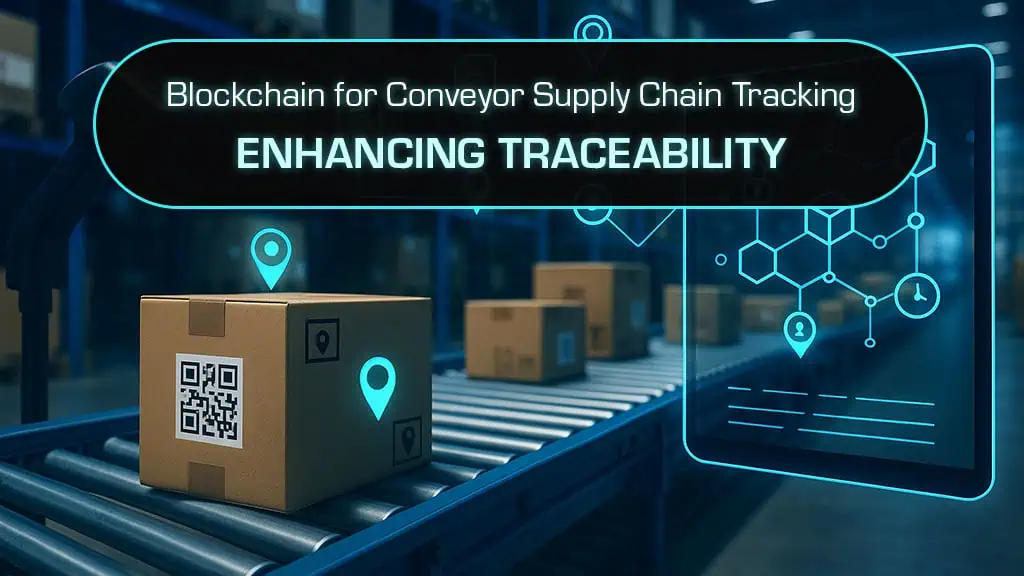
How Blockchain Secures Every Move on Your Conveyor Line
Conveyors move products every day, but in modern supply chains, speed isn’t the only concern. Companies now face mounting pressure to prove exactly where materials come from and how they’re handled. For food and pharma, the stakes are even higher. Recalls can easily climb past a million dollars and put businesses at major risk.
That’s why some operations are looking at blockchain in conveyor systems. Instead of relying on paper logs or siloed databases, blockchain creates a record of movement that’s secure, permanent, and accessible when it’s needed most.
- How Blockchain Secures Every Move on Your Conveyor Line
- What Blockchain Looks Like in a Conveyor System
- Why Traceability Can’t Be Ignored
- Where Blockchain Makes the Most Difference
- How Conveyor Material Tracking Integration Works
- Why Companies Are Taking Notice of Blockchain in Conveyor Systems
- Looking Ahead for Supply Chain Traceability in Conveyor Systems
- Russell Conveyor Can Help You with Your Automated Conveyor System
What Blockchain Looks Like in a Conveyor System
Most people connect blockchain with digital money. In reality, it’s simply a ledger that can’t be tampered with. Every time a product moves down a conveyor, that event can be logged into the system.
The difference is that blockchain entries are verified across a network and locked in place. No editing, no backdating. That means supply chain traceability conveyors provide an honest account of what happened, start to finish.
Why Traceability Can’t Be Ignored
Early studies suggest that traceability systems cut recall costs by nearly half, simply because teams can identify problems quickly and act fast. For any business moving high-value or sensitive goods, that level of control is game-changing.
- A single food recall can top $1 million in direct costs.
- Pharma recalls can climb even higher once compliance fines and potential lawsuits are added.
- Customers and regulators alike expect more visibility than ever.
Where Blockchain Makes the Most Difference
Some industries feel the cost of poor tracking more than others. That’s where blockchain tied to conveyors has the strongest payoff:
- Food & Beverage
Recalls move fast. With blockchain, every step is logged, from storage temperatures to transfer times.
- Pharma
Batch numbers, expiration dates, and hand-offs are recorded in a way that can’t be changed later.
- Automotive
Parts sourcing stays clear, helping reduce the risk of counterfeits slipping into the line.
- E-commerce
Orders can be tracked through each hand-off, giving buyers more confidence in delivery.
If compliance is tight or if margins are thin, conveyor material tracking with blockchain takes pressure off the operation.
How Conveyor Material Tracking Integration Works
Blockchain doesn’t change how a conveyor runs. It works alongside. But how does it work?
- Data Capture
Sensors capture data, such as product IDs, weight, and timestamps.
- Logging
Events are logged to the blockchain ledger.
- Verification
Verification happens automatically across the network.
- Record Keeping
A permanent record is created with no edits possible.
- Access
With supply tracking in place, you’ll be able to provide on-demand access for managers and regulators.
Why Companies Are Taking Notice of Blockchain in Conveyor Systems
Why is blockchain technology such a sought-after aspect of modern production?
- Records can’t be altered or erased.
- Problem batches can be tracked in hours, not weeks.
- Compliance audits go smoother with verified data.
- Customers gain confidence in sourcing and handling.
- Systems scale from one warehouse to global operations.
In industries where trust matters, conveyor material tracking with blockchain is starting to look less like a luxury and more like the next step forward.
Looking Ahead for Supply Chain Traceability in Conveyor Systems
Blockchain is still new in material handling, but the direction is clear. As more facilities adopt IoT monitoring and automation, the need for blockchain will grow stronger. It allows businesses to establish supply chains that are harder to break and easier to trust.
If you’re hoping to take advantage of increased production numbers, better on-demand monitoring, and increased transparency and security, implementing supply chain traceability is a must.
Russell Conveyor Can Help You with Your Automated Conveyor System
Supply chains are under more scrutiny than ever. Blockchain offers a way to answer where products were made, who handled them, and when they moved. Pairing that technology with conveyors gives businesses a level of visibility that wasn’t possible before.
Russell Conveyor builds systems already geared for IoT and blockchain integration. If compliance is weighing on your operation, now’s the time to plan ahead. We manufacture our products in-house and design custom setups that keep your system moving safely and transparently at all times.
Ready to strengthen your supply chain? Call us at (336) 526-3014 and request a Free Compliance Consultation today. We’ll answer your questions and design a custom system that keeps your business moving efficiently and transparently.
FAQs about Blockchain in Conveyor Systems
Not at all. Many solutions scale down for small facilities.
No. IoT-enabled conveyors can be retrofitted for blockchain use. Check out our conveyor retrofit services.
Completely secure. Once logged, entries can’t be changed or deleted.
No. Tracking runs in the background and doesn’t affect speed or numbers.
Data is stored locally and synced later, so records stay complete.
Yes. Recall savings and smoother audits often outweigh setup costs.